.png)
Por favor, use este identificador para citar o enlazar este ítem:
https://hdl.handle.net/11000/39477Registro completo de metadatos
| Campo DC | Valor | Lengua/Idioma |
|---|---|---|
| dc.contributor.author | Almada, Ana Clara | - |
| dc.contributor.author | Mereles-Rodríguez, Beda | - |
| dc.contributor.author | CHADE, MIRIAM | - |
| dc.contributor.author | Belinchón Romero, Isabel | - |
| dc.contributor.author | Deschutter, Enrique Jorge | - |
| dc.contributor.author | Ramos Rincón, José Manuel | - |
| dc.contributor.other | Departamentos de la UMH::Medicina Clínica | es_ES |
| dc.date.accessioned | 2026-03-05T09:39:16Z | - |
| dc.date.available | 2026-03-05T09:39:16Z | - |
| dc.date.created | 2025-03 | - |
| dc.identifier.citation | J Fungi (Basel) . 2025 Mar 23;11(4):245 | es_ES |
| dc.identifier.issn | 2309-608X | - |
| dc.identifier.uri | https://hdl.handle.net/11000/39477 | - |
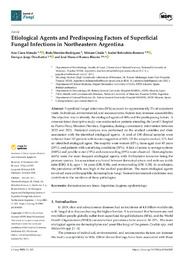
| dc.description.abstract | Superficial fungal infections (SFIs) account for approximately 2% of outpatient visits. Individual, environmental, and socioeconomic factors may increase susceptibility. The objective was to identify the etiological agents of SFIs and the predisposing factors. A cross-sectional descriptive study was conducted on patients attending the Level I Hospital in Puerto Piray, Misiones Province, Argentina, during a community intervention between 2022 and 2023. Statistical analysis was performed on the studied variables and their association with the identified etiological agents. A total of 138 clinical samples were collected from 107 patients with lesions suggestive of SFIs. Of the samples studied, 37% had an identified etiological agent. The majority were women (65%), those aged over 45 years (29%), and patients with underlying conditions (50%). A lack of access to sewage systems (100%) and potable water (19%) and overcrowding (19%) were observed. Dermatophytes (46%) were the most frequent etiological agents, with Trichophyton tonsurans being the primary species. An association was found between dermatophytosis and male sex (odds ratio [OR]: 4.4), ages 1-14 years (OR: 8.04), and overcrowding (OR: 5.38). In conclusion, the prevalence of SFIs was high in the studied population. The main etiological agents involved were anthropophilic dermatophyte fungi. Socioenvironmental conditions may contribute to the incidence of these pathologies. | es_ES |
| dc.format | application/pdf | es_ES |
| dc.format.extent | 16 | es_ES |
| dc.language.iso | eng | es_ES |
| dc.publisher | MDPI | es_ES |
| dc.rights | info:eu-repo/semantics/openAccess | es_ES |
| dc.rights | Attribution-NonCommercial-NoDerivatives 4.0 Internacional | * |
| dc.rights.uri | http://creativecommons.org/licenses/by-nc-nd/4.0/ | * |
| dc.subject | Argentina | es_ES |
| dc.subject | dermatomycoses | es_ES |
| dc.subject | epidemiology | es_ES |
| dc.title | Etiological Agents and Predisposing Factors of Superficial Fungal Infections in Northeastern Argentina | es_ES |
| dc.type | info:eu-repo/semantics/article | es_ES |
| dc.relation.publisherversion | 10.3390/jof11040245 | es_ES |
Ver/Abrir:
Etiological Agents and Predisposing Factors of Superficial Fungal Infections in Northeastern Argentina.pdf
2,78 MB
Adobe PDF
Compartir:
 La licencia se describe como: Atribución-NonComercial-NoDerivada 4.0 Internacional.