.png)
Por favor, use este identificador para citar o enlazar este ítem:
https://hdl.handle.net/11000/39474Registro completo de metadatos
| Campo DC | Valor | Lengua/Idioma |
|---|---|---|
| dc.contributor.author | Quijada Cazorla, María Asunción | - |
| dc.contributor.author | Simó Rodríguez, María Virgilia | - |
| dc.contributor.author | Palacios-Marqués, Ana María | - |
| dc.contributor.author | Peláez García, María | - |
| dc.contributor.author | Ramos Rincón, José Manuel | - |
| dc.contributor.other | Departamentos de la UMH::Medicina Clínica | es_ES |
| dc.date.accessioned | 2026-03-05T09:36:59Z | - |
| dc.date.available | 2026-03-05T09:36:59Z | - |
| dc.date.created | 2025-07 | - |
| dc.identifier.citation | J Clin Med . 2025 Jul 19;14(14):5136 | es_ES |
| dc.identifier.issn | 2077-0383 | - |
| dc.identifier.uri | https://hdl.handle.net/11000/39474 | - |
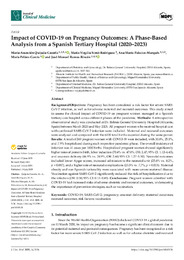
| dc.description.abstract | Background/Objectives: Pregnancy has been considered a risk factor for severe SARS-CoV-2 infection, as well as for adverse maternal and neonatal outcomes. This study aimed to assess the clinical impact of COVID-19 on pregnant women managed at a Spanish tertiary care hospital across different phases of the pandemic. Methods: A retrospective observational study was conducted at Dr. Balmis General University Hospital (Alicante, Spain) between March 2020 and May 2023. All pregnant women who received hospital care with confirmed SARS-CoV-2 infection were included. Maternal and neonatal outcomes were analyzed and compared with the 6120 total births recorded during the same period. Results: A total of 249 pregnant women with COVID-19 were included, with 30.8%, 25.0%, and 7.9% hospitalized during each respective pandemic phase. The overall incidence of infection was 41 cases per 1000 births. Hospitalized pregnant women showed significantly higher rates of preterm birth, labor induction (70.4% vs. 47.0%; OR: 2.67; 95% CI: 1.12-6.43), and cesarean delivery (46.9% vs. 24.9%, OR: 2.60; 95% CI: 1.27-5.50). Neonatal outcomes included lower Apgar scores, increased admission to the neonatal unit (25.8% vs. 8.2%, p = 0.007), and a higher rate of neonatal complications (23.3% vs. 7.7%, p = 0.015). Maternal obesity and non-Spanish nationality were associated with more severe maternal disease. Vaccination against SARS-CoV-2 significantly reduced the risk of hospitalization due to the infection (OR: 0.30; 95% CI: 0.13-0.69). Conclusions: Pregnant women admitted with COVID-19 had increased risks of adverse obstetric and neonatal outcomes, underscoring the importance of preventive strategies, such as vaccination. | es_ES |
| dc.format | application/pdf | es_ES |
| dc.format.extent | 18 | es_ES |
| dc.language.iso | eng | es_ES |
| dc.publisher | MDPI | es_ES |
| dc.rights | info:eu-repo/semantics/openAccess | es_ES |
| dc.rights | Attribution-NonCommercial-NoDerivatives 4.0 Internacional | * |
| dc.rights.uri | http://creativecommons.org/licenses/by-nc-nd/4.0/ | * |
| dc.subject | COVID-19 | es_ES |
| dc.subject | SARS-CoV-2 | es_ES |
| dc.subject | cesarean delivery | es_ES |
| dc.title | Impact of COVID-19 on Pregnancy Outcomes: A Phase-Based Analysis from a Spanish Tertiary Hospital (2020-2023) | es_ES |
| dc.type | info:eu-repo/semantics/article | es_ES |
| dc.relation.publisherversion | 10.3390/jcm14145136 | es_ES |
Ver/Abrir:
Impact of COVID-19 on Pregnancy Outcomes A Phase-Based Analysis from a Spanish Tertiary Hospital (2020-2023).pdf
851,89 kB
Adobe PDF
Compartir:
 La licencia se describe como: Atribución-NonComercial-NoDerivada 4.0 Internacional.