.png)
Por favor, use este identificador para citar o enlazar este ítem:
https://hdl.handle.net/11000/39472Registro completo de metadatos
| Campo DC | Valor | Lengua/Idioma |
|---|---|---|
| dc.contributor.author | Vogel, Mara Angelina | - |
| dc.contributor.author | Silva, Gustavo Alfredo | - |
| dc.contributor.author | Otero-Rodríguez, Silvia | - |
| dc.contributor.author | Deschutter, Enrique Jorge | - |
| dc.contributor.author | Ramos Rincón, José Manuel | - |
| dc.contributor.other | Departamentos de la UMH::Medicina Clínica | es_ES |
| dc.date.accessioned | 2026-03-05T09:21:25Z | - |
| dc.date.available | 2026-03-05T09:21:25Z | - |
| dc.date.created | 2024-04 | - |
| dc.identifier.citation | J Infect Public Health . 2024 Apr;17(4):663-668 | es_ES |
| dc.identifier.issn | 1876-0341 | - |
| dc.identifier.uri | https://hdl.handle.net/11000/39472 | - |
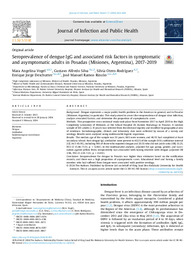
| dc.description.abstract | Background: Dengue represents a major public health problem in the Americas in general, and in Posadas (Misiones, Argentina) in particular. This study aimed to assess the seroprevalence of dengue virus infection, analyze associated factors, and determine the proportion of asymptomatic cases. Methods: This prospective cross-sectional study took place from November 2017 to April 2019 in the High Complexity Laboratory of Misiones, at the School Hospital Dr. Ramón Madariaga in Posadas. A random sample of 301 adults (≥ 15 years) was selected from the electoral registry and stratified by geographical area of residence. Sociodemographic, clinical, and laboratory data were collected by means of a survey and serology. Results were analyzed using multivariable logistic regression. Results: The median age of the sample was 33 years; 66% were women, and 46.5% had completed at least secondary school. Anti-dengue IgG antibodies were present in 40.2% of the sample (95% confidence interval [CI] 34.5-45.9%), including 90% of those who reported dengue and 20.5% who did not (odds ratio [OR] 33.25, 95% CI 15.46-71.51, p < 0.001). In the multivariable analysis, adjusted for age, group, gender, and vaccination against yellow fever, seropositivity was associated with having relatives with dengue (adjusted OR 3.96, 95% CI 2.18-7.23; p < 0.001). Conclusion: Seroprevalence for dengue in Posadas was higher than estimates based on the notification records, and there was a high proportion of asymptomatic cases. Educational level and having a family member who had suffered from dengue were associated with positive serology. | es_ES |
| dc.format | application/pdf | es_ES |
| dc.format.extent | 6 | es_ES |
| dc.language.iso | eng | es_ES |
| dc.publisher | Elsevier | es_ES |
| dc.rights | info:eu-repo/semantics/openAccess | es_ES |
| dc.rights | Attribution-NonCommercial-NoDerivatives 4.0 Internacional | * |
| dc.rights.uri | http://creativecommons.org/licenses/by-nc-nd/4.0/ | * |
| dc.subject | antibodies | es_ES |
| dc.subject | Argentina | es_ES |
| dc.subject | dengue | es_ES |
| dc.title | Seroprevalence of dengue IgG and associated risk factors in symptomatic and asymptomatic adults in Posadas (Misiones, Argentina), 2017-2019 | es_ES |
| dc.type | info:eu-repo/semantics/article | es_ES |
| dc.relation.publisherversion | 10.1016/j.jiph.2024.02.002 | es_ES |
Ver/Abrir:
Seroprevalence of dengue IgG and associated risk factors in symptomatic and asymptomatic adults in Posadas (Misiones, Argentina), 2017-2019.pdf
1,45 MB
Adobe PDF
Compartir:
 La licencia se describe como: Atribución-NonComercial-NoDerivada 4.0 Internacional.