.png)
Por favor, use este identificador para citar o enlazar este ítem:
https://hdl.handle.net/11000/39470Registro completo de metadatos
| Campo DC | Valor | Lengua/Idioma |
|---|---|---|
| dc.contributor.author | Nacarapa, Edy | - |
| dc.contributor.author | Jose, Bendita | - |
| dc.contributor.author | Munyangaju, Isabelle | - |
| dc.contributor.author | Osório , Dulce | - |
| dc.contributor.author | Ramos Rincón, José Manuel | - |
| dc.contributor.other | Departamentos de la UMH::Medicina Clínica | es_ES |
| dc.date.accessioned | 2026-03-05T09:19:48Z | - |
| dc.date.available | 2026-03-05T09:19:48Z | - |
| dc.date.created | 2025-10 | - |
| dc.identifier.citation | Sci Rep . 2025 Oct 21;15(1):36748 | es_ES |
| dc.identifier.issn | 2045-2322 | - |
| dc.identifier.uri | https://hdl.handle.net/11000/39470 | - |
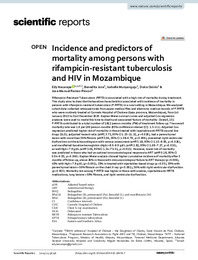
| dc.description.abstract | Rifampicin-Resistant Tuberculosis (RRTB) is associated with a high risk of mortality during treatment. This study aims to describe the baseline characteristics associated with incidence of mortality in persons with rifampicin-resistant tuberculosis (P-RRTB) in a rural setting in Mozambique. We analyzed cohort data collected retrospectively from paper medical files and electronic medical records of P-RRTB who were routinely treated at Carmelo Hospital of Chokwe (Gaza province, Mozambique), from 1st January 2015 to 31st December 2020. Kaplan-Meier survival curves and adjusted Cox regression analyses were used to model the time to death and associated factors of mortality. Overall, 151 P-RRTB contributed to a total number of 1812 person-months (PM) of treatment follow-up. The overall mortality rate was 1.9 per 100 person-months (95% confidence interval [CI]: 1.3-2.1). Adjusted Cox regression predicted higher risk of mortality in those treated with injectable anti-RRTB second line drugs (SLD), (adjusted hazard ratio [aHR] 3.72, 95% CI 1.23-11.22, p = 0.020), had a parenchymal lesion with more than 50% fibrosis (aHR 3.06, 95% CI 1.38-6.79, p = 0.006), presented right ventricular dysfunction on the echocardiogram with venous assessment (aHR 3.18, 95% CI 1.15-8.83, p = 0.026), and manifested baseline hemoglobin (Hgb) = 8.0-9.9 g/dL (aHR 2.82, 95% CI 1.09-7.27, p = 0.032), as well Hgb < 7.9 g/dL (aHR 3.06, 95%CI 1.24-7 0.51, p = 0.015). However, lower risk of mortality was predicted in those who had an optimal immunovirological response to ART (aHR 0.18, 95% CI 0.04-0.93, p = 0.040). Kaplan-Meier analysis showed higher cumulative incidence of mortality after 3 months of follow-up, above 26% in those with immunovirological failure to ART therapy (p = 0.006), 45% with Hgb < 7.9 g/dL (p < 0.001), 23% in treated with injectables-based drugs (p = 0.03), 39% with parenchymal lesion > 50% fibrosis on the chest X-ray (p < 0.001), 56% with right ventricular dysfunction (p = 0.003). Mortality risk among P-RRTB was higher in those with anemia, injectable anti-RRTB medications, lung lesions > 50% fibrosis, and right ventricular dysfunction. | es_ES |
| dc.format | application/pdf | es_ES |
| dc.format.extent | 15 | es_ES |
| dc.language.iso | eng | es_ES |
| dc.publisher | Nature | es_ES |
| dc.rights | info:eu-repo/semantics/openAccess | es_ES |
| dc.rights | Attribution-NonCommercial-NoDerivatives 4.0 Internacional | * |
| dc.rights.uri | http://creativecommons.org/licenses/by-nc-nd/4.0/ | * |
| dc.subject | RRTB | es_ES |
| dc.subject | risk of mortality | es_ES |
| dc.title | Incidence and predictors of mortality among persons with rifampicin-resistant tuberculosis and HIV in Mozambique | es_ES |
| dc.type | info:eu-repo/semantics/article | es_ES |
| dc.relation.publisherversion | 10.1038/s41598-025-20658-7 | es_ES |
Ver/Abrir:
Incidence and predictors of mortality among persons with rifampicin-resistant tuberculosis and HIV in Mozambique.pdf
4,04 MB
Adobe PDF
Compartir:
 La licencia se describe como: Atribución-NonComercial-NoDerivada 4.0 Internacional.