Título :
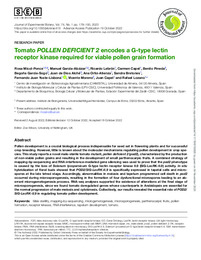
Tomato POLLEN DEFICIENT 2 encodes a G-type lectin receptor kinase required for viable pollen grain formation |
Autor :
Micol-Ponce, Rosa
García-Alcázar, Manuel
Lebrón, Ricardo
Capel, Carmen
Pineda, Benito
García-Sogo, Begoña
Alché, Juan de Dios
Ortiz-Atienza, Ana
Bretones, Sandra
Yuste-Lisbona, Fernando Juan
Moreno, Vicente
Capel, Juan
Lozano, Rafael |
Editor :
Oxford University Press |
Departamento:
Departamentos de la UMH::Biología Aplicada |
Fecha de publicación:
2023 |
URI :
https://hdl.handle.net/11000/39452 |
Resumen :
Pollen development is a crucial biological process indispensable for seed set in flowering plants and for successful
crop breeding. However, little is known about the molecular mechanisms regulating pollen development in crop species. This study reports a novel male-sterile tomato mutant, pollen deficient 2 (pod2), characterized by the production
of non-viable pollen grains and resulting in the development of small parthenocarpic fruits. A combined strategy of
mapping-by-sequencing and RNA interference-mediated gene silencing was used to prove that the pod2 phenotype
is caused by the loss of Solanum lycopersicum G-type lectin receptor kinase II.9 (SlG-LecRK-II.9) activity. In situ
hybridization of floral buds showed that POD2/SlG-LecRK-II.9 is specifically expressed in tapetal cells and microspores at the late tetrad stage. Accordingly, abnormalities in meiosis and tapetum programmed cell death in pod2
occurred during microsporogenesis, resulting in the formation of four dysfunctional microspores leading to an aberrant microgametogenesis process. RNA-seq analyses supported the existence of alterations at the final stage of
microsporogenesis, since we found tomato deregulated genes whose counterparts in Arabidopsis are essential for
the normal progression of male meiosis and cytokinesis. Collectively, our results revealed the essential role of POD2/
SlG-LecRK-II.9 in regulating tomato pollen development.
|
Palabras clave/Materias:
Male sterility
mapping-by-sequencing
microgametogenesis
microsporogenesis
parthenocarpic fruits
pollen formation
receptor kinases
RNA interference
tapetum development
tomato |
Área de conocimiento :
CDU: Ciencias puras y naturales |
Tipo de documento :
info:eu-repo/semantics/article |
Derechos de acceso:
info:eu-repo/semantics/openAccess
Attribution-NonCommercial-NoDerivatives 4.0 Internacional |
DOI :
https://doi.org/10.1093/jxb/erac419 |
Publicado en:
Journal of Experimental Botany, Vol. 74, No. 1 pp. 178–193, 2023 |
Aparece en las colecciones:
Artículos - Biología Aplicada
|
.png)
 La licencia se describe como: Atribución-NonComercial-NoDerivada 4.0 Internacional.