Título :
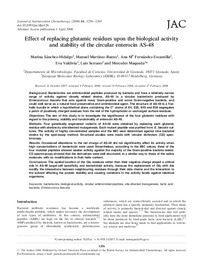
Effect of replacing glutamic residues upon the biological activity and stability of the circular enterocin AS-48 |
Autor :
Sánchez-Hidalgo, Marina
Martínez-Bueno, Manuel
Fernández-Escamilla, Ana Mª
Valdivia, Eva
Serrano, Luis
Maqueda, Mercedes |
Editor :
Oxford University Press |
Departamento:
Departamentos de la UMH::Bioquímica y Biología Molecular |
Fecha de publicación:
2008 |
URI :
https://hdl.handle.net/11000/39311 |
Resumen :
Background: Bacteriocins are antimicrobial peptides produced by bacteria and have a relatively narrow
range of activity against closely related strains. AS-48 is a circular bacteriocin produced by
Enterococcus faecalis that acts against many Gram-positive and some Gram-negative bacteria, and
could well serve as a natural food preservative and antimicrobial agent. The structure of AS-48 is a fivehelix
bundle in which a hypothetical plane containing the Ca atoms of E4, E20, E49 and E58 segregates
a patch of positively charged residues from the rest of the hydrophobic or uncharged surface residues.
Objectives: The aim of this study is to investigate the significance of the four glutamic residues with
regard to the potency, stability and functionality of enterocin AS-48.
Methods: Four genetically engineered variants of AS-48 were obtained by replacing each glutamic
residue with alanine by site-directed mutagenesis. Each mutant peptide was purified from E. faecalis cultures.
The activity of highly concentrated samples and the MIC were determined against nine bacterial
strains by the spot-assay method. Structural studies were made with circular dichroism (CD) spectroscopy.
Results: Occasional alterations to the net charge of AS-48 did not significantly affect its activity when
high concentrations of bacteriocin were used. Nevertheless, according to the MIC values, three of the
four mutated peptides showed weaker activity against the majority of the Gram-positive bacteria tested.
CD spectroscopy showed that the derivatives were well structured, in a similar way to those of the native
molecule, with no modifications in their helix content.
Conclusions: The spatial location of the Glu residues rather than their negative charge played a critical
role in AS-48 target-cell specificity and bactericidal activity, because the replacement of Glu with Ala
modify the interactions between neighbouring residues through their side chains and the interaction to
the solvent affecting the protein stability and causing variations in the activity levels against identical
organisms.
|
Palabras clave/Materias:
bacteriocins
biological activity
circular antimicrobial peptides
site-directed mutagenesis
lactic acid bacteria
Enterococcus faecalis |
Área de conocimiento :
CDU: Ciencias puras y naturales: Biología: Biología celular y subcelular. Citología |
Tipo de documento :
info:eu-repo/semantics/article |
Derechos de acceso:
info:eu-repo/semantics/openAccess |
DOI :
10.1093/jac/dkn126 |
Publicado en:
Journal of Antimicrobial Chemotherapy, Vol. 61, Issue 6 (2008) pp. 1256-1265 |
Aparece en las colecciones:
Artículos - Bioquímica y Biología Molecular
|
.png)
 La licencia se describe como: Atribución-NonComercial-NoDerivada 4.0 Internacional.