.png)
Please use this identifier to cite or link to this item:
https://hdl.handle.net/11000/38982Full metadata record
| DC Field | Value | Language |
|---|---|---|
| dc.contributor.author | Briones-Valdivieso, Camilo | - |
| dc.contributor.author | Salerno, P.R.V.O. | - |
| dc.contributor.author | Navarrete-Muñoz, Eva María | - |
| dc.contributor.author | Valera-Gran, Desirée | - |
| dc.contributor.author | López-Bueno, R. | - |
| dc.contributor.author | Al kindi, Salam | - |
| dc.contributor.author | Deo, S.V. | - |
| dc.contributor.author | Petermann Rocha, Fanny | - |
| dc.contributor.other | Departamentos de la UMH::Patología y Cirugía | es_ES |
| dc.date.accessioned | 2026-01-23T08:52:16Z | - |
| dc.date.available | 2026-01-23T08:52:16Z | - |
| dc.date.created | 2024-10 | - |
| dc.identifier.citation | Public Health. 2024 Oct:235:211-218 | es_ES |
| dc.identifier.issn | 0033-3506 | - |
| dc.identifier.uri | https://hdl.handle.net/11000/38982 | - |
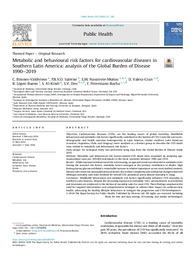
| dc.description.abstract | Objectives: Cardiovascular diseases (CVDs) are the leading causes of global mortality. Modifiable behavioural and metabolic risk factors significantly contribute to the burden of CVD. Given the vast socio-demographic and health outcome heterogeneity in Latin America, similar southern Latin American countries (Argentina, Chile, and Uruguay) were analysed as a distinct group to describe the CVD death rates related to metabolic and behavioural risk factors. Study design: An ecological study was performed using data from the Global Burden of Disease Study 2019. Methods: Metabolic and behavioural risk factors-related CVD death were examined by analysing age-standardised rates per 100,000 individuals in the three countries between 1990 and 2019. Results: While exposure to behavioural risk is decreasing, an upwards trend was observed in metabolic risks. Among the assessed risk factors, metabolic factors emerged as the primary contributors to deaths. High fasting plasma glucose exhibited a remarkable increase in relative importance across most studied contexts. Dietary risks stood out among behavioural factors due to their complexity and substantial changes observed. Although mortality rates have declined for overall CVD, peripheral artery disease mortality is rising. Conclusion: Modifiable behavioural and metabolic risk factors significantly influence CVD mortality in Southern Latin America. Despite the increasing exposure to metabolic risks, advancements in prevention and treatment are evidenced in the decline of mortality rates for most CVD. These findings emphasise the need for targeted interventions and comprehensive strategies to address their impact on cardiovascular health, advocating for healthy lifestyle behaviours to mitigate the progression and CVD development. | es_ES |
| dc.format | application/pdf | es_ES |
| dc.format.extent | 8 | es_ES |
| dc.language.iso | eng | es_ES |
| dc.publisher | Elsevier | es_ES |
| dc.rights | info:eu-repo/semantics/openAccess | es_ES |
| dc.rights | Attribution-NonCommercial-NoDerivatives 4.0 Internacional | * |
| dc.rights.uri | http://creativecommons.org/licenses/by-nc-nd/4.0/ | * |
| dc.subject | Cardiovascular disease | es_ES |
| dc.subject | Metabolic risk | es_ES |
| dc.subject | Behavioural risk | es_ES |
| dc.subject | Ischaemic heart disease | es_ES |
| dc.subject | Stroke | es_ES |
| dc.subject | Peripheral artery disease | es_ES |
| dc.title | Metabolic and behavioural risk factors for cardiovascular diseases in Southern Latin America: analysis of the Global Burden of Disease 1990-2019 | es_ES |
| dc.type | info:eu-repo/semantics/article | es_ES |
| dc.relation.publisherversion | 10.1016/j.puhe.2024.06.039 | es_ES |
View/Open:
Metabolic and behavioural risk factors for cardiovascular diseases in.PDF
1,8 MB
Adobe PDF
Share:
