.png)
Please use this identifier to cite or link to this item:
https://hdl.handle.net/11000/38823Full metadata record
| DC Field | Value | Language |
|---|---|---|
| dc.contributor.author | Rodríguez Caro, Roberto | - |
| dc.contributor.author | Graciá, Eva | - |
| dc.contributor.author | Blomberg, Simone | - |
| dc.contributor.author | Cayuela, Hugo | - |
| dc.contributor.author | Grace, Molly K. | - |
| dc.contributor.author | Carmona, Carlos P | - |
| dc.contributor.author | Pérez Mendoza, Hibraim Adán | - |
| dc.contributor.author | Giménez Casalduero, Andrés | - |
| dc.contributor.author | Salguero Gómez, Rob | - |
| dc.contributor.other | Departamentos de la UMH::Biología Aplicada | es_ES |
| dc.date.accessioned | 2025-12-22T10:43:02Z | - |
| dc.date.available | 2025-12-22T10:43:02Z | - |
| dc.date.created | 2023 | - |
| dc.identifier.citation | Nature Communications | es_ES |
| dc.identifier.issn | 2041-1723 | - |
| dc.identifier.uri | https://hdl.handle.net/11000/38823 | - |
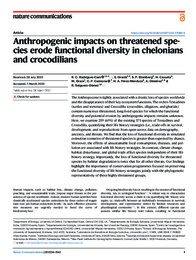
| dc.description.abstract | The Anthropocene is tightly associated with a drastic loss of species worldwide and the disappearance of their key ecosystem functions. The orders Testudines (turtles and tortoises) and Crocodilia (crocodiles, alligators, and gharials) contain numerous threatened, long-lived species for which the functional diversity and potential erosion by anthropogenic impacts remains unknown. Here, we examine 259 (69%) of the existing 375 species of Testudines and Crocodilia, quantifying their life history strategies (i.e., trade-offs in survival, development, and reproduction) from open-access data on demography, ancestry, and threats. We find that the loss of functional diversity in simulated extinction scenarios of threatened species is greater than expected by chance. Moreover, the effects of unsustainable local consumption, diseases, and pollution are associated with life history strategies. In contrast, climate change, habitat disturbance, and global trade affect species independent of their life history strategy. Importantly, the loss of functional diversity for threatened species by habitat degradation is twice that for all other threats. Our findings highlight the importance of conservation programmes focused on preserving the functional diversity of life history strategies jointly with the phylogenetic representativity of these highly threatened groups. | es_ES |
| dc.format | application/pdf | es_ES |
| dc.format.extent | 10 | es_ES |
| dc.language.iso | eng | es_ES |
| dc.publisher | Nature Research | es_ES |
| dc.relation.ispartofseries | Vol. 14 | es_ES |
| dc.rights | info:eu-repo/semantics/openAccess | es_ES |
| dc.rights | Attribution-NonCommercial-NoDerivatives 4.0 Internacional | * |
| dc.rights.uri | http://creativecommons.org/licenses/by-nc-nd/4.0/ | * |
| dc.subject.other | CDU::5 - Ciencias puras y naturales::57 - Biología | es_ES |
| dc.title | Anthropogenic impacts on threatened species erode functional diversity in chelonians and crocodilians | es_ES |
| dc.type | info:eu-repo/semantics/article | es_ES |
| dc.relation.publisherversion | https://doi.org/10.1038/s41467-023-37089-5 | es_ES |
View/Open:
s41467-023-37089-5 (1).pdf
1,38 MB
Adobe PDF
Share:
