.png)
Por favor, use este identificador para citar o enlazar este ítem:
https://hdl.handle.net/11000/38795Registro completo de metadatos
| Campo DC | Valor | Lengua/Idioma |
|---|---|---|
| dc.contributor.author | Sánchez Ferrer, Francisco | - |
| dc.contributor.author | CORTÉS CASTELL, ERNESTO | - |
| dc.contributor.author | Carratalá Marco, Francisco | - |
| dc.contributor.author | Juste Ruiz, Mercedes | - |
| dc.contributor.author | Quesada Rico, José Antonio | - |
| dc.contributor.author | Nso-Roca, Ana Pilar | - |
| dc.contributor.other | Departamentos de la UMH::Medicina Clínica | es_ES |
| dc.contributor.other | Departamentos de la UMH::Farmacología, Pediatría y Química Orgánica | es_ES |
| dc.date.accessioned | 2025-12-15T08:43:08Z | - |
| dc.date.available | 2025-12-15T08:43:08Z | - |
| dc.date.created | 2021-04 | - |
| dc.identifier.citation | BMC Pediatr . 2021 Apr 20;21(1):185 | es_ES |
| dc.identifier.issn | 1471-2431 | - |
| dc.identifier.uri | https://hdl.handle.net/11000/38795 | - |
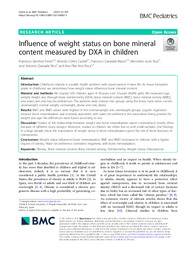
| dc.description.abstract | Introduction: Childhood obesity is a public health problem with repercussions in later life. As tissue formation peaks in childhood we determined how weight status influences bone mineral content. Material and methods: We studied 553 children aged 4-18 years over 10 years (46.8% girls). We measured age, weight, height and through bone densitometry (DXA), bone mineral content (BMC), bone mineral density (BMD), and waist, arm and hip circumferences. The patients were divided into groups using the body mass index z-score: underweight, normal weight, overweight, obese and very obese. Results: BMC and BMD values were highest in the normal-weight and overweight groups. Logistic regression showed bone mineralization was inversely associated with waist circumference, the association being positive for weight and age. No differences were found according to sex. Discussion: Studies of the relationship between weight and bone mineralization report contradictory results, often because of different study designs. Moreover, studies in children are either few or with small samples. Our findings in a large sample show the importance of weight status in bone mineralization given the risk of bone fractures or osteoporosis. Conclusions: Weight status influenced bone mineralization. BMC and BMD decreased in children with a higher degree of obesity. Waist circumference correlated negatively with bone mineralization. | es_ES |
| dc.format | application/pdf | es_ES |
| dc.format.extent | 8 | es_ES |
| dc.language.iso | eng | es_ES |
| dc.publisher | BMC | es_ES |
| dc.rights | info:eu-repo/semantics/openAccess | es_ES |
| dc.rights | Attribution-NonCommercial-NoDerivatives 4.0 Internacional | * |
| dc.rights.uri | http://creativecommons.org/licenses/by-nc-nd/4.0/ | * |
| dc.subject | obesity | es_ES |
| dc.subject | bone mineral density | es_ES |
| dc.subject | densiometry | es_ES |
| dc.subject | weight status | es_ES |
| dc.subject | osteoporosis | es_ES |
| dc.title | Influence of weight status on bone mineral content measured by DXA in children | es_ES |
| dc.type | info:eu-repo/semantics/article | es_ES |
| dc.relation.publisherversion | 10.1186/s12887-021-02665-5 | es_ES |
Ver/Abrir:
Influence of weight status on bone mineral content measured by DXA in children.pdf
729,29 kB
Adobe PDF
Compartir:
 La licencia se describe como: Atribución-NonComercial-NoDerivada 4.0 Internacional.