.png)
Please use this identifier to cite or link to this item:
https://hdl.handle.net/11000/38608Full metadata record
| DC Field | Value | Language |
|---|---|---|
| dc.contributor.author | Fernández Gómez, Lola | - |
| dc.contributor.author | Sanchéz Zapata, José Antonio | - |
| dc.contributor.author | Donázar, José Antonio | - |
| dc.contributor.author | Barber i Vallés, Josep Xavier | - |
| dc.contributor.author | Barbosa, Jomar Magalhães | - |
| dc.contributor.other | Departamentos de la UMH::Estadística, Matemáticas e Informática | es_ES |
| dc.date.accessioned | 2025-12-01T09:07:43Z | - |
| dc.date.available | 2025-12-01T09:07:43Z | - |
| dc.date.created | 2024 | - |
| dc.identifier.citation | Science of the Total Environment | es_ES |
| dc.identifier.issn | 1879-1026 | - |
| dc.identifier.issn | 0048-9697 | - |
| dc.identifier.uri | https://hdl.handle.net/11000/38608 | - |
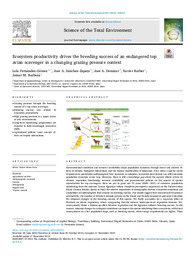
| dc.description.abstract | Environmental conditions and resource availability shape population dynamics through direct and indirect effects of climate, biological interactions and the human modification of landscape. Even when a species seems dependent on predictable anthropogenic food resources or subsidies, ecosystem-level factors can still determine population dynamics across taxa. However, there is still a knowledge gap about the cascade effects driven by climate, vegetation functioning, resource availability and governmental policies on key aspects of species reproduction for top scavengers. Here we put to good use 22 years (2000−2021) of extensive population monitoring from the endemic Canary Egyptian vulture (Neophron percnopterus majorensis) on the Fuerteventura Island (Canary Islands, Spain) to study the relative importance of demographic factors, ecosystem conditions and availability of anthropogenic food sources on breeding success. Our results suggest that ecosystem-level primary productivity, the number of livestock animals present on the island and Density-dependent processes determine the temporal changes in the breeding success of this species. We firstly accounted for a top-down effect of livestock on island vegetation, where overgrazing directly reduces landscape-level vegetation biomass. We, consequently, found a bottom-up effect between vegetation and the Egyptian vulture's breeding success. In this context, minimal changes in ecological conditions can impact the species inhabiting these ecosystems, with direct consequences on a key population stage, such as breeding season, when energy requirements are higher. These results are especially relevant because cascading and indirect effects of ecosystem processes and governmental policies are often overlooked when pursuing conservation goals of endangered species. | es_ES |
| dc.format | application/pdf | es_ES |
| dc.format.extent | 9 | es_ES |
| dc.language.iso | eng | es_ES |
| dc.publisher | Elsevier | es_ES |
| dc.relation.ispartofseries | Vol. 910 | es_ES |
| dc.rights | info:eu-repo/semantics/openAccess | es_ES |
| dc.rights | Attribution-NonCommercial-NoDerivatives 4.0 Internacional | * |
| dc.rights.uri | http://creativecommons.org/licenses/by-nc-nd/4.0/ | * |
| dc.subject | agricultural policies | es_ES |
| dc.subject | anthropogenic resources | es_ES |
| dc.subject | carrion | es_ES |
| dc.subject | demography | es_ES |
| dc.subject | regime shift | es_ES |
| dc.subject | trophic cascade | es_ES |
| dc.subject.other | CDU::5 - Ciencias puras y naturales::57 - Biología::574 - Ecología general y biodiversidad | es_ES |
| dc.subject.other | CDU::3 - Ciencias sociales::31 - Demografía. Sociología. Estadística::311 - Estadística | es_ES |
| dc.title | Ecosystem productivity drives the breeding success of an endangered top avian scavenger in a changing grazing pressure context | es_ES |
| dc.type | info:eu-repo/semantics/article | es_ES |
| dc.relation.publisherversion | https://doi.org/10.1016/j.scitotenv.2023.168553 | es_ES |
View/Open:
Ecosystem productivity drives the breeding success of an.pdf
2,5 MB
Adobe PDF
Share:
