.png)
Por favor, use este identificador para citar o enlazar este ítem:
https://hdl.handle.net/11000/38600Registro completo de metadatos
| Campo DC | Valor | Lengua/Idioma |
|---|---|---|
| dc.contributor.author | Zarza-Arribas, María | - |
| dc.contributor.author | Menárguez Puche, Juan Francisco | - |
| dc.contributor.author | Morales López, Rosario | - |
| dc.contributor.author | Barber Valles, Josep Xavier | - |
| dc.contributor.author | Orozco Beltrán, Domingo Luis | - |
| dc.contributor.other | Departamentos de la UMH::Estadística, Matemáticas e Informática | es_ES |
| dc.date.accessioned | 2025-12-01T08:41:20Z | - |
| dc.date.available | 2025-12-01T08:41:20Z | - |
| dc.date.created | 2024-03 | - |
| dc.identifier.citation | Journal of Primary Care & Community Health (JPC), Volume 15: 1–9 (2024) | es_ES |
| dc.identifier.issn | 2150-1327 | - |
| dc.identifier.issn | 2150-1319 | - |
| dc.identifier.uri | https://hdl.handle.net/11000/38600 | - |
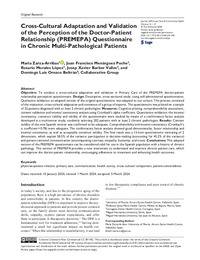
| dc.description.abstract | Objective: To conduct a cross-cultural adaptation and validation in Primary Care of the PREMEPA doctor-patient relationship perception questionnaire. Design: Descriptive, cross-sectional study, using self-administered questionnaires. Qualitative validation: an adapted version of the original questionnaire, was adapted to our culture. The process consisted of the evaluation, cross-cultural adaptation and consensus of a group of experts. The questionnaire was piloted on a sample of 32 patients diagnosed with at least 2 chronic pathologies. Measures: Cognitive piloting, comprehensibility assessment, content validation and internal consistency analysis using Cronbach’s alpha coefficient. Quantitative validation: the internal consistency, construct validity and validity of the questionnaire were studied by means of a confirmatory factor analysis developed in a multicenter study, randomly selecting 202 patients with at least 2 chronic pathologies. Results: Content validity of the new Spanish version was confirmed to be adequate. Comprehensibility and internal consistency (Cronbach’s α coefficient = 0.78) were adequate. The confirmatory factor analysis showed good dimensionality, factor relationship and internal consistency, as well as acceptable construct validity. The final result was a 13-item questionnaire consisting of 2 dimensions, which explain 58.5% of the variance: participation in decision-making (accounting for 45.2% of the variance) and person-centered communication (encompassing courtesy, empathy, humanity, and trust). Conclusions: This adapted version of the PREMEPA questionnaire can be considered valid for use in the Spanish population with a history of chronic pathology. This version of PREMEPA provides a new instrument to understand and improve chronic patient care, which can improve the doctor-patient relationship, encouraging adherence to treatment and enhancing health outcomes | es_ES |
| dc.format | application/pdf | es_ES |
| dc.format.extent | 9 | es_ES |
| dc.language.iso | eng | es_ES |
| dc.publisher | SAGE Publications | es_ES |
| dc.rights | info:eu-repo/semantics/openAccess | es_ES |
| dc.rights | Attribution-NonCommercial-NoDerivatives 4.0 Internacional | * |
| dc.rights.uri | http://creativecommons.org/licenses/by-nc-nd/4.0/ | * |
| dc.subject | physician-patient relation | es_ES |
| dc.subject | primary care | es_ES |
| dc.subject | communication | es_ES |
| dc.subject | health survey | es_ES |
| dc.subject | cross-cultural comparison | es_ES |
| dc.subject | patient-centeredness | es_ES |
| dc.subject.other | CDU::5 - Ciencias puras y naturales::50 - Generalidades sobre las ciencias puras | es_ES |
| dc.title | Cross-Cultural Adaptation and Validation of the Perception of the Doctor-Patient Relationship (PREMEPA) Questionnaire in Chronic Multi-Pathological Patients | es_ES |
| dc.type | info:eu-repo/semantics/article | es_ES |
| dc.relation.publisherversion | https://doi.org/10.1177/21501319241241198 | es_ES |
Ver/Abrir:
Cross-Cultural Adaptation and Validation.pdf
551,25 kB
Adobe PDF
Compartir:
 La licencia se describe como: Atribución-NonComercial-NoDerivada 4.0 Internacional.