.png)
Por favor, use este identificador para citar o enlazar este ítem:
https://hdl.handle.net/11000/37758Registro completo de metadatos
| Campo DC | Valor | Lengua/Idioma |
|---|---|---|
| dc.contributor.author | Díaz González, Marcos | - |
| dc.contributor.author | Plaza Caballero, Pablo | - |
| dc.contributor.author | Blanco Fernández, David | - |
| dc.contributor.author | Jordan Vidal, Manuel M. | - |
| dc.contributor.author | Sáez del Bosque, Isabel Fuencisla | - |
| dc.contributor.author | MEDINA MARTÍNEZ, CÉSAR | - |
| dc.contributor.other | Departamentos de la UMH::Agroquímica y Medio Ambiente | es_ES |
| dc.date.accessioned | 2025-10-31T09:53:19Z | - |
| dc.date.available | 2025-10-31T09:53:19Z | - |
| dc.date.created | 2021-08-23 | - |
| dc.identifier.citation | Materials 2021, 14(16), 4762 | es_ES |
| dc.identifier.issn | 1996-1944 | - |
| dc.identifier.uri | https://hdl.handle.net/11000/37758 | - |
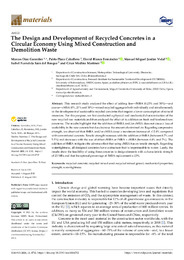
| dc.description.abstract | This research study analysed the effect of adding fine—fMRA (0.25% and 50%)—and coarse—cMRA (0%, 25% and 50%)—mixed recycled aggregate both individually and simultaneously in the development of sustainable recycled concretes that require a lower consumption of natural resources. For this purpose, we first conducted a physical and mechanical characterisation of the new recycled raw materials and then analysed the effect of its addition on fresh and hardened new concretes. The results highlight that the addition of fMRA and/or cMRA does not cause a loss of workability in the new concrete but does increase the amount of entrained air. Regarding compressive strength, we observed that fMRA and/or cMRA cause a maximum increase of +12.4% compared with conventional concrete. Tensile strength increases with the addition of fMRA (between 8.7% and 5.5%) and decreases with the use of either cMRA or fMRA + cMRA (between 4.6% and 7%). The addition of fMRA mitigates the adverse effect that using cMRA has on tensile strength. Regarding watertightness, all designed concretes have a structure that is impermeable to water. Lastly, the results show the feasibility of using these concretes to design elements with a characteristic strength of 25 MPa and that the optimal percentage of fMRA replacement is 25%. | es_ES |
| dc.format | application/pdf | es_ES |
| dc.format.extent | 22 | es_ES |
| dc.language.iso | eng | es_ES |
| dc.publisher | MDPI | es_ES |
| dc.rights | info:eu-repo/semantics/openAccess | es_ES |
| dc.rights | Attribution-NonCommercial-NoDerivatives 4.0 Internacional | * |
| dc.rights.uri | http://creativecommons.org/licenses/by-nc-nd/4.0/ | * |
| dc.subject | recycled concrete | es_ES |
| dc.subject | recycled mixed sand | es_ES |
| dc.subject | recycled mixed gravel | es_ES |
| dc.subject | mechanical properties | es_ES |
| dc.subject | strength | es_ES |
| dc.subject | watertightness | es_ES |
| dc.subject.other | CDU::5 - Ciencias puras y naturales | es_ES |
| dc.title | The Design and Development of Recycled Concretes in a Circular Economy Using Mixed Construction and Demolition Waste | es_ES |
| dc.type | info:eu-repo/semantics/article | es_ES |
| dc.relation.publisherversion | https://doi.org/10.3390/ma14164762 | es_ES |
Ver/Abrir:
Aportacion sustitutoria 2.pdf
2,77 MB
Adobe PDF
Compartir:
 La licencia se describe como: Atribución-NonComercial-NoDerivada 4.0 Internacional.